21 September, 2020

After a car accident, it is common for victims to experience painful symptoms that affect mobility, strength, and daily routine. Pain, numbness, tingling, or weakness in the lower back, buttocks, hip, or one leg after a crash may be signs of sciatica, a condition that can develop as a result of accident-related trauma.
Sciatica refers to pain that travels along the sciatic nerve, which runs from the lower back through the hips and buttocks and down each leg. The pain can range from a mild ache to sharp, burning, or radiating discomfort. Sciatica usually affects one side of the body, but the severity and duration of symptoms can vary from person to person.
Sciatica can develop after a car accident when the force of the collision injures the lower back or spine. The impact of the crash may damage spinal discs, strain soft tissues, or cause inflammation that places pressure on the sciatic nerve. Depending on the severity of the injury and resulting symptoms, sciatica after a car accident can significantly affect a person’s mobility, comfort, and overall quality of life.
A car accident can cause sciatica when the impact injures the lower back or spine in a way that compresses or irritates the sciatic nerve. This may happen if the crash causes a herniated disc, bulging disc, narrowing of the spinal canal, inflammation, or other trauma affecting the connective tissue and structures around the spine. During a collision, the body can be forced forward, backward, or sideways with significant force. This sudden movement may strain the muscles, ligaments, discs, and joints in the back. If a spinal disc shifts or becomes damaged, it may press against the sciatic nerve and trigger pain that travels into the buttocks, hip, or leg.
A car accident may also aggravate a pre-existing back condition. For example, someone who already had lower back issues may experience new or worsening sciatica symptoms after a crash. Even if symptoms were not present before the accident, the trauma from the collision may make an underlying condition painful.
Sciatica symptoms may appear shortly after a crash, or they may develop over time as inflammation increases. If pain continues beyond the first few days or worsens, the injury may be more serious than ordinary post-accident soreness.
Common symptoms of sciatica after a car accident may include:
These symptoms can limit a person’s ability to walk, drive, work, exercise, or complete daily tasks. Because sciatica symptoms can overlap with other back and nerve injuries, medical records may be important in identifying the cause of the pain and documenting how the injury developed after the crash.
If you later pursue a car accident injury claim, the insurance company may review your medical records, treatment timeline, and symptoms to evaluate your claim. Documentation can help show when symptoms began, how the injury affected your life, and whether the symptoms may be connected to the accident.
A medical provider may evaluate your symptoms, medical history, and physical limitations to determine whether sciatica may be present after a car accident. During an exam, the provider may check reflexes, muscle strength, range of motion, and whether certain movements increase pain.
Common physical tests may include walking on your toes or heels, rising from a squatting position, or lifting the leg while lying down. Because sciatic pain often worsens with certain movements, these evaluations may help identify whether the sciatic nerve is involved. If symptoms are severe, persistent, or worsening, a provider may request imaging or diagnostic testing. These tests may help determine whether a herniated disc, spinal injury, or nerve compression is causing the symptoms.
Common diagnostic tools may include:
These records may also be useful in a personal injury claim because they can help connect the symptoms to the accident and show the severity of the injury.
Treatment for sciatica depends on the cause and severity of the symptoms. Some cases may improve over time with conservative care, while more serious cases may require additional treatment. A medical provider may recommend a treatment plan based on the patient’s condition, symptoms, and diagnostic results.
Common treatment for sciatica may include:
Prescription medication may include anti-inflammatory medication, muscle relaxers, or other medication recommended by a provider. Physical therapy may be used to strengthen the muscles that support the back, improve flexibility, and reduce pressure on the sciatic nerve. Steroid injections may be recommended in some cases to reduce inflammation around the affected nerve root. Surgery is usually only considered when other treatment options do not provide relief or when the compressed nerve causes serious symptoms, such as significant weakness or loss of bladder or bowel control. Because every case is different, the recovery timeline for sciatica after a car accident can vary. Some people improve within weeks, while others may experience ongoing symptoms for months or longer.
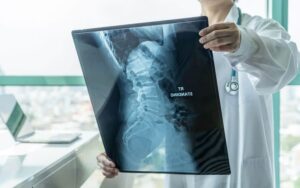
doctor looking at a spinal xray of a patient injured in an accident
Sciatica after a car accident may affect a personal injury claim if the condition causes medical expenses, missed work, pain, reduced mobility, or long-term limitations. The value of a claim may depend on the severity of the symptoms, the evidence connecting the condition to the crash, and how the injury affects daily life.
A claim involving sciatica may include compensation for:
Insurance companies may question whether sciatica was caused by the accident, especially if the injured person had prior back problems. Medical records, imaging results, symptom documentation, and consistent treatment records may help support the claim.
Sciatica after a car accident can be painful, limiting, and stressful. If another driver’s negligence caused your crash, you may be able to pursue compensation for medical costs, property damage, lost wages, pain and suffering, and other damages.
At The Barnes Firm, we understand how stressful and confusing this time can be for injured victims. Our team of experienced car accident attorneys can review your case, explain your legal options, and help determine whether sciatica or another back injury may support a personal injury claim. For a free consultation with an experienced attorney, complete an online contact form or call our office at (800) 800-0000.
Written by The Barnes Firm, reviewed by Richard Barnes
Richard Barnes: “As President of The Barnes Firm, I have dedicated my career to achieving justice in hundreds of cases for the victims of injuries caused through the fault of others. Additionally, I have been honored to have been elected Best Lawyer and a Super Lawyer”
Years of Experience: 30+ years
LinkedIn Profile: Richard Barnes

Getting our clients the best results possible.
or call us at
(800) 800-0000

“I had an outstanding experience with The Barnes Firm, thanks to Nahuel Cruz and Aybike Donuk. Their professionalism, expertise, and dedication were evident through...
“Both Jeff Bodily and Mayra Wallis were wonderful to deal with. Very professional, knowledgeable, supportive and helped me navigate through a very stressful time af...
“My personal Injury Attorney was Jake Otis, he provided accurate timely advise and encouragement throughout the process. He is a true gentleman , his knowledge and ...
“I’ve had an exceptional experience with Mory Ahmadi, Esq. from the Barnes Firm. Mory’s professionalism, knowledge of personal injury law, and compassionate app...
“My personal injury lawyer was The Barnes Firm, they helped me with my injury lawsuit. I can’t thank them enough! John Sheehan and his team were there for me ever...
“I had a great experience working with Richard Amico and his team. They were responsive to my questions and got me a great settlement. They definitely were working ...

This page has been written, edited, and reviewed by a team of legal writers following our comprehensive editorial guidelines. This page was approved by attorney president Rich Barnes who has more than 30+ years of legal experience as a practicing personal injury trial attorney.
The Barnes Firm is here to help you. Our personal injury firm helps individuals and their families who
have suffered an injury in an accident.
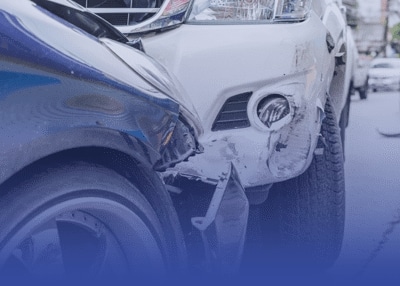
Whether your car crash was minor or serious, any injuries sustained in an accident can be painful and costly.

All motorcycle accidents are different, the compensation you receive will depend on the circumstances surrounding your accident.

A truck accident can be catastrophic, even in low-impact crashes, if you or your family are involved, you may be entitled to significant financial compensation.

There are dozens of accidents involving school buses each year, most commonly, involving children outside a school bus.
Explore Articles Related to Your Situation

What happens if you get pulled over without your license on you? Before anyone can operate a ve...
read more
With so many options for legal representation, finding the best car accident attorneys in Calif...
read more
Leasing a car is a popular option for many drivers, as it offers flexibility and often lower mo...
read more
After a car accident, pain, stress, and confusion can make it difficult to know what to do next...
read moreWe are always available to discuss your case. Give us a call at (800) 800-0000.
Fill out our form and we will contact you shortly to discuss your case
Our attorneys will come to your home, office or hospital at your convenience.
We are available anytime, including after hours and
weekends.
500 Pearl Street
Suite #700
Buffalo, NY 14202
Phone: (800) 800-0000
Fax: +1 (800) 853-5153
420 Lexington Avenue
Suite #2140
New York, NY 10170
Phone: (800) 800-0000
Fax: +1 (800) 853-5153
600 Old Country Road
Suite #425
Garden City, NY 11530
Phone: (800) 800-0000
Fax: +1 (800) 853-5153
28 East Main Street
Suite #600
Rochester, NY 14614
Phone: (800) 800-0000
Fax: +1 (800) 853-5153
451 Grider Street
Buffalo, NY 14215
Phone: (800) 800-0000
Fax: +1 (800) 853-5153
633 West 5th Street
Suite #1750
Los Angeles, CA 90071
Phone: (800) 800-0000
Fax: +1 (888) 800-7050
555 12th Street
Suite #1470
Oakland, CA 94607
Phone: (800) 800-0000
Fax: +1 (888) 800-7050
655 W. Broadway
Suite #940
San Diego, CA 92101
Phone: (800) 800-0000
Fax: +1 (888) 800-7050
